
Why that happens
This is not a criticism. The reasons are easy enough to guess.
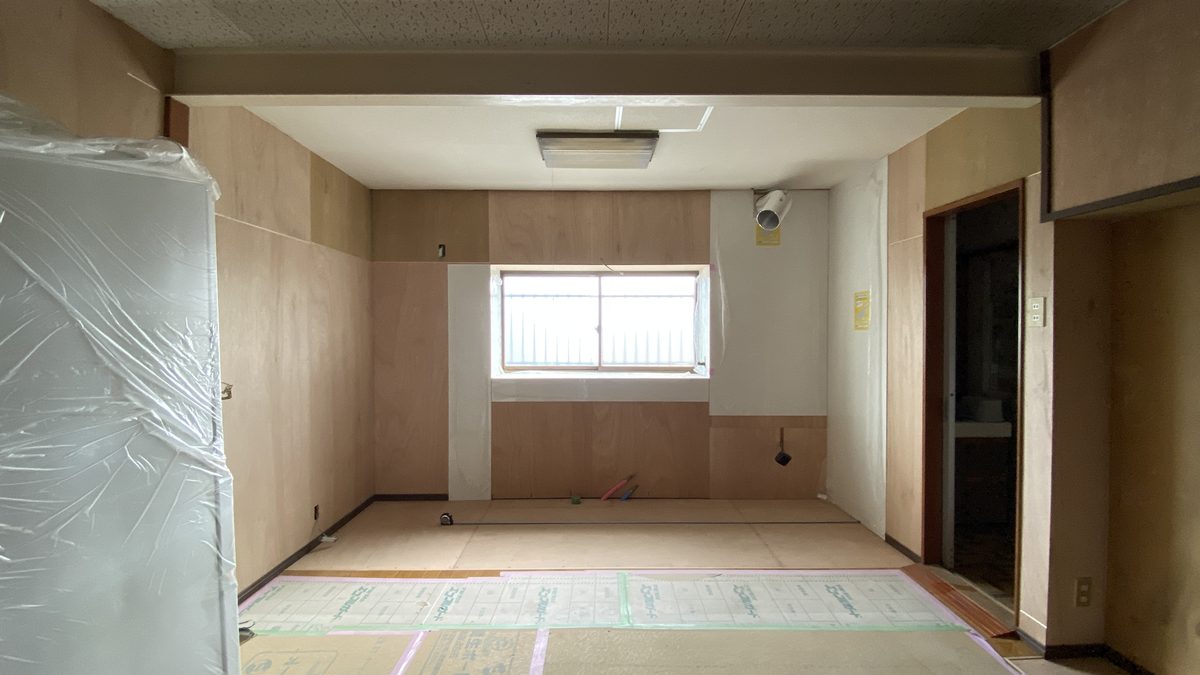
There is no room to photograph the job. On a site with a fixed programme, stopping work to set up a camera is not simple. There may be photos taken as a record, but they are close-ups of walls and fittings, and there turn out to be very few wide shots you could put on a website.
The property becomes identifiable. A building visible through the window, a nameplate, a unit number. Restoration means handling somebody else’s asset, so the photos you can publish as they are are a limited set.
A site mid-strip-out is seen as “messy”. A floor lifted, substrate showing — it is not pretty, that much is true. We imagine it is judged hard to use as sales material.
Illustrations are cheap and quick. Buy a few from a stock site and the page is filled the same day.
What that leads to
The result is that every company’s site ends up with the same face.
From the reader’s side, the illustration tells them nothing. What the finish is like, what tradespeople the firm has, how it deals with damaged substrate. It gives you nothing to judge by.
When a management company or an owner is looking for a contractor, in the end they choose on “do these people look like they will do it properly?” What works there is not a good drawing but a photo with an actual job in it.
What ought to be done (and where we actually are)
The ideal is clear. Every photo on a company’s site ought to be from that company’s own jobs. That is the strongest thing you can do.
But you cannot get there in one step. The site photos we have were taken as a record, mostly close-ups of walls and fittings. There are few wide shots, and the ones with a building visible through the window we cannot publish because the property could be identified. We also do not, at present, have a matched before-and-after pair of the same room.
So what should we hold to in the meantime? This is how we see it.
- Any image that is not our own ought to be labelled as such. On this site we put “photo for illustration only (Photo AC)”
- Project write-ups ought not to use someone else’s photos. Put a photo of a different room next to a table of area, programme and scope, and it will be taken as a photo of that job. Until we have our own photos, our project write-ups use a logo-only image
- Buying paid stock photos to “look like you have a track record” ought not to be done. Free stock is enough for post illustrations, and where something is missing we think you can simply say so
- Build the photo library up and swap them in one at a time as they come. Try to do it all at once and you end up with borrowed material again
With that said, here is where we actually are. This site also carries illustrations and photos borrowed from elsewhere. In other words we are, in part, making the same “fill it with illustrations” choice we opened with. Writing something that reads like criticism while doing it ourselves. There is no point hiding it, so we are writing it down.
The only difference is that we make it possible to see which photos are ours and which are not. Not turning “we do not have enough” into “it looks like we have enough”. That is as far as we can get right now.
One way to look at it when choosing a contractor
If you are a management company or an owner comparing contractors, there is one thing worth checking when you look at a site.
Is that photo from that company’s own job?
Does the projects page put before and after of the same room side by side? Are the people doing the work in shot? Are there photos of damaged substrate? A company that shows the inconvenient states as well is, we think, more likely to be one that does not hide things on site either.
We will be building up our own photos from here.